
On Jan. 16, 2026, 28 Years Later: Bone Temple premiered, directed by Nia DaCosta. The film continued the 28…Later franchise, which began in 2002 with 28 Days Later directed by Danny Boyle. Continuing from the previous film 28 Years Later Bone Temple further explores the mysterious biology of the infected and human life years after the outbreak.
The film is rated R, particularly for intense violence, gore and language. Bone Temple follows 28 Years Later and serves as the second part to the trilogy. The first film, 28 Days is rated R, similarly to the most recent addition, however, differences in violence are apparent between the two. In the first two films, most of the violence stems from the rage-infected humans, which are often referred to as “zombies”–mindless with driven rage targeted toward humans. Bone Temple changes the narrative of violence in the story. Instead of the central fear and danger being the infected, it becomes other people.
At the end of the first 28 Years film, a group of similarly dressed blondes encounter the child protagonist, Spike. Bone Temple delves further into these characters and how they live on the sparsely populated European islands. Spoilers for the most recent films are included beyond this point!
In 28 Years the story follows Spike (portrayed by Alfie Williams) and his father, Jamie (portrayed by Aaron Taylor Johnson). They navigate life and survival on an island homing refugees. In the beginning of the film, we see Jamie teach Spike how to kill an infected person when needed. When they find an abandoned house with a mutilated infected strung up intricately from the ceiling, danger turns its focus from non-human, zombified violence to violence only capable by man. This specific scene connects to the final scene of the movie, where Spike is alone and encounters the group of people that mutilated the infected person from the house. These people, clad in colorful tracksuits, blonde wigs and masks made of shoes, are called the “Jimmies,” named after their leader, Sir Lord Jimmy Crystal (portrayed by Jack O’Connell).
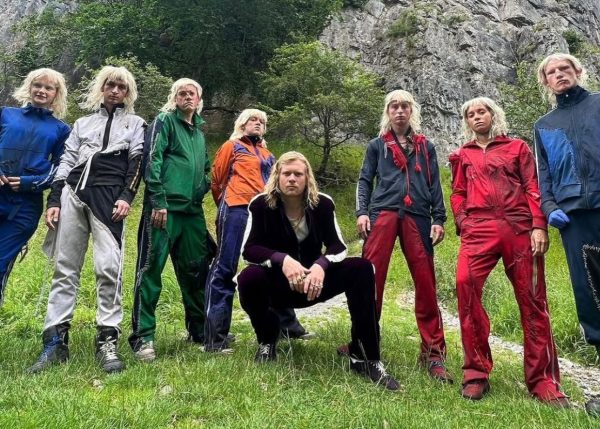
The Jimmies character designs are important to the setting of the 28 films. The outbreak began around 2002, meaning that culture was frozen in time. This is further represented by Sir Jimmy Crystal’s obsession with Teletubbies, a British children’s show. While not explicitly stated in the film, the tracksuit look of the Jimmies are based on late British TV personality Jimmy Savile. The relevance of this connection is Savile’s numerous crimes against people, specifically children. In late 2012 following his death, Savile was outed for the sexual abuse of hundreds, meaning that it was not worldwide knowledge when the fictional outbreak occured. Because Savile was popular in children’s media, Jimmy Crystal was familiar with Savile, and in turn was visually inspired by him. This emphasizes how people continue life after traumatic events that put a halt on the world they were familiar with. Jimmy Crystal is an intensely childish yet violent character that believes he is the son of Satan (Old Nick) that survived the apocalypse with no adult guidance, unlike Spike.
The group of Jimmies, including Spike, travels to find the doctor Jimmy believes to be Old Nick, or his father. Spike is familiar with the doctor because he treated his sick mother. After coming to an agreement with Jimmy Crystal, Dr. Kelson (portrayed by Ralph Fiennes) pretends to be Satan. Previous to this encounter, Dr. Kelson begins to communicate with an infected person, referred to as the “Alpha,” due to his immense size and command over the other infected. He experiments with him, giving him doses of morphine in an attempt to humanize him and essentially find a cure to the rage virus that has plagued humanity for nearly three decades.
Because Bone Temple takes place immediately after 28 Years, Spike has not aged. However, there are numerous emotional changes that occur. Exposed to the rancid violence of the Jimmies, he is forced to witness and do things to others that he would never do if he was still with his father. The emotional connection he has with his mother from the first film is somewhat replicated with the only Jimmy that shows him sympathy and wants to flee the Jimmies, Jimmy Ink. By the end of the film, Spike continues his journey onward with Jimmy Ink, hardened yet still the same timid young boy he was from the first film.
The ongoing 28 Years franchise introduces an outlook of the world after the outbreak that was not the central focus of the first three films, exploring the effects of media, religion and lack of civilization on vulnerable people. Even though the focuses of the film are different, they are still connected through the obvious infected, but also characters from the first film!