

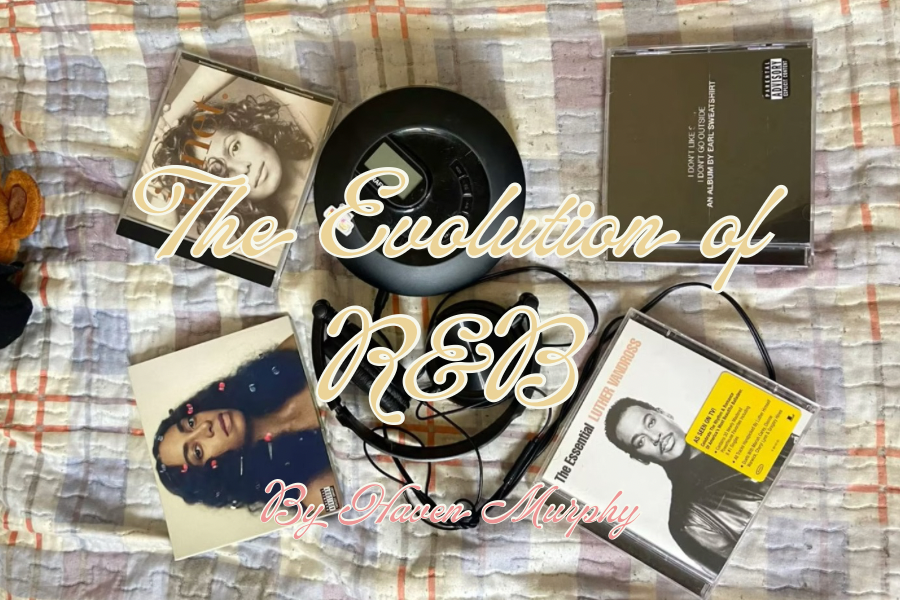
The music genre, “rhythm and blues” –most often referred to as R&B–originated in 1940s African American communities. The creation of the genre intended for a distinction of sound in Black music, relevant during the ‘90s where hip-hop was immensely popular. Even though distinction was intentional to separate certain kinds of music, the sound of Black music is ever-changing and popular genres constantly combine, creating unique subgenres like new jack swing, neo-soul and even recent fusions like trap&b.
Even though R&B came about in the ‘40s with notable genres like doo wop and boogie-woogie, the genre is usually identified by voices and production techniques from the ‘80s and ‘90s. Artists like Michael Jackson, The Gap Band, Minnie Riperton, Stevie Wonder and Marvin Gaye–just to name a few–defined the sound of R&B throughout the ‘70s, setting a standard for artists to come in the ‘80s. Vocalists like Whitney Houston blended R&B and pop, as well as groups like New Edition, who flourished in pop, rap and later influenced the new jack swing sound.
My musical hot take:groups pioneered the “Golden Era” of R&B, and it is especially evident throughout the ‘90s. Vocal powerhouse groups like Jodeci, SWV and Bell Biv DeVoe dominated charts and contributed to the specific harmonic and “love-dovey” sound commonly associated with R&B as a whole. Multi-performer collectives continued throughout following decades, an example being Destiny’s Child in the 2000s. However, R&B groups seem to have reached their peak in the 2000s, as the 2010s are highlighted by soloists. Many of which, like Summer Walker, SZA and Frank Ocean, may be more recognizable to younger audiences (like you and me!). Because groups are not as popular in American mainstream music as they used to be, the transition to single performers from groups is one of many key differences in R&B today. It symbolizes a major difference in musical production.
In groups, one person can make up for what another is unable to do and turn this collaboration into a production where individual talent is shown in ways that recognizes each member’s abilities. An example of this is harmonization and line distribution. Instead of a weaker vocalist receiving main, vocal heavy parts, they would instead harmonize or provide back vocals for the stronger singer, further elevating the quality of the song. An example of this is the ballad, “Can You Stand The Rain” (1988) by New Edition. Throughout the song, two voices (Johnny Gill and Ralph Tresvant) are most noticeable out of five total. This is because the remaining members maintained the chorus and supporting vocals.
My point is not to say that R&B artists today are not prioritizing quality production, but instead, many artists today do not utilize the same production techniques that elevated voices in the past. One of my favorite modern R&B songs is “Body” (2019) by Summer Walker. The official recording has a signature, nearly distorted autotuned sound to it, with minimal harmonies. While I think this has become a unique key feature in Walker’s music, I also think it highlights the lack of quality and hunger that vocalists used to almost need to have in order to be successful. SWV’s renowned “Weak” (1992) is sung mostly by Cheryl Gamble. However, one of the defining characteristics of the song is the additional harmonies and adlibs done by the other two members alongside her. Comparing SWV to Summer Walker seems like a big stretch; however, it is not just about vocal ability and talent, but also technique. It is not impossible for a vocalist to harmonize with themselves, especially with the technology used today in music. The problem is, these techniques are underutilized and instead, the quantity of songs and artists are put above quality, and in turn results in multiple artists who display a drastic downgrade in artistry.
Even with the frequent development of technology in music, many productions nowadays lack the original, truly unique feel. A very popular example of this is sampling in production, which goes far beyond just R&B. It is not a new thing for songs to sample bits and pieces or even instrumentals of another song. However, when samples are used in songs today, oftentimes that sample is not used to contribute to the uniqueness of a song, but instead to accompany a mediocre beat. This “sample mania” further contributes to the lack of originality in the current mainstream R&B scene today.
It is not a secret that r&b is a genre originating from Black culture and is still dominated by Black voices. Like with most genres, there is a definitive look that is associated with the music. For R&B, that “look” is just Black culture. People who are not Black have always been a part of popular Black music, whether they are producers or artists themselves. An example I am fond of is Teena Marie! However, just because they have always been a part of it, does not mean that it has not always been a dramatized, almost mocking emulation of Black culture.
Many musicians across different genres have profited on basing their look around Black culture without possessing any kind of ties to it, often failing to credit their inspiration. In music today, this includes dressing or attempting to behave like the culture a certain genre is based around. An example of this that may be rather unknown to younger audiences is the origins of the artist Pink, who is known for her eccentric pop-rock discography and appearance. However, the early sound of her career was based upon R&B, and in turn, promoted her as a “cornrow-wearing” blue-eyed soul act. Even though this was pushed by her label, it is important to point out that this is still a problem in Black-dominated spaces today. Good music will be listened to regardless of what kind of mockery the artist is emulating, but said mockery is absolutely not a requirement to attempt to profit and create.
R&B has evolved drastically from the soulful “Golden Age,” because of the constantly growing surrounding genres like rap, hip-hop and electronic that weave throughout it to create new sounds. Rather than lacking quality as a whole, modern R&B finds its golden ability in fusion.
Even though it may sound different than what it used to be and may lack quality in certain aspects, music and creativity is an ever-growing vessel, and it is naive to assume something so vibrant can stay the same forever.


Ireen❤️ • Mar 6, 2026 at 9:58 am
I love it